
Tyler Previous Residents Source Span
One Tyler address has several time layers. The current appraisal record anchors the parcel, while recorded instruments carry the legal description backward through owners. Directories and Kriss Kross books add listed address or telephone clues. Census schedules describe a household at the census date, and maps or permits can establish the building's context. Each source has gaps, so use the strongest source for the period rather than forcing every question through a modern search box.
| Source | Years It Covers | Where Held | What It Shows |
|---|---|---|---|
| Current SCAD parcel roll | Current annual roll; exact online start not located | SCAD website or office | Owner, mailing and situs addresses, account, legal description, values, and map route; not every occupant |
| County deed records | Online cutoff not stated; documented historic books 1846-1906 | Smith County Clerk and East Texas A&M microfilm | Transfers, party roles, and legal descriptions; old street numbers may be absent |
| Tyler city directories | 1882-1999 listed years, with gaps | Tyler Public Library and Historical Society | Listed names, addresses, businesses, and telephone details by volume |
| Kriss Kross directories | 1958-1959, 1962-1969, 1971-1973, 1974-1988, 1993-1994 | Tyler Public Library and Historical Society | Address or telephone route to a listed name |
| Federal census | 1790-1950 public; 1960 releases later | NARA, library databases, and genealogy services | Household composition at the census date, with geography that can differ from a street address |
| Sanborn and permits | Tyler 1885 Sanborn; current permit start not located | UNT, Library of Congress, Society, and City eTRAKiT | Building footprint or property work history, not a resident list |
For recent transfers, start with the parcel and deed. For a mid-century name at a known address, start with Kriss Kross. For a nineteenth-century lot, the legal description, map, deed books, and directory context normally matter more than a modern street number.
Tyler Parcel First, Then the Deed
Freeze the modern parcel before following past residents. Smith County Appraisal District maintains ownership records, tax maps, appraisal information, exemptions, and property-tax addresses. Record the SCAD account or parcel number, owner name, mailing address, situs address, subdivision, lot and block, plus any visible improvement data. The mailing address is where tax correspondence goes. The situs address is the physical taxable location. Neither one proves that every person associated with an address actually lived there.
Then move to the recorded instrument. A deed is about a transfer and legal description, not a current-occupancy list. Trusts, estates, liens, releases, correction instruments, and powers of attorney can also place a name in the record. That is why the legal description, recording date, document number or book and page, and party role are more useful than a name alone.
Use Smith County Appraisal District to locate the current property record, then follow the document route through the County Clerk. The live SCAD interface was not fully captured in the research, so verify its displayed fields before relying on a parcel-card detail.
Note: A mailing address may aid the property trail, but it does not establish that its recipient lived at the situs.
Tyler Previous Residents and Official Records
The Smith County Official Public Records Quick Search has a Property Records department, a Search Term box for grantor, grantee, subdivision, document type, or document number, recorded-date fields, and quick date ranges. Index Only searches indexed metadata and separates multiple words. Index & Full Text searches document OCR and treats multiple words as a phrase. Names are usually best tested in Index Only first, then a distinctive legal-description phrase can be checked in OCR.
The portal reports a current certification marker, but the official sources do not publish its earliest online index year. Do not infer an online start date from an empty result. The older bridge is documented deed and index microfilm. The County Clerk's Official Public Records page also notes that valid identification is required when presenting in-person Property Department documents, a counter rule distinct from the online index.
The Official Records search is the source of the current grantor-grantee interface.
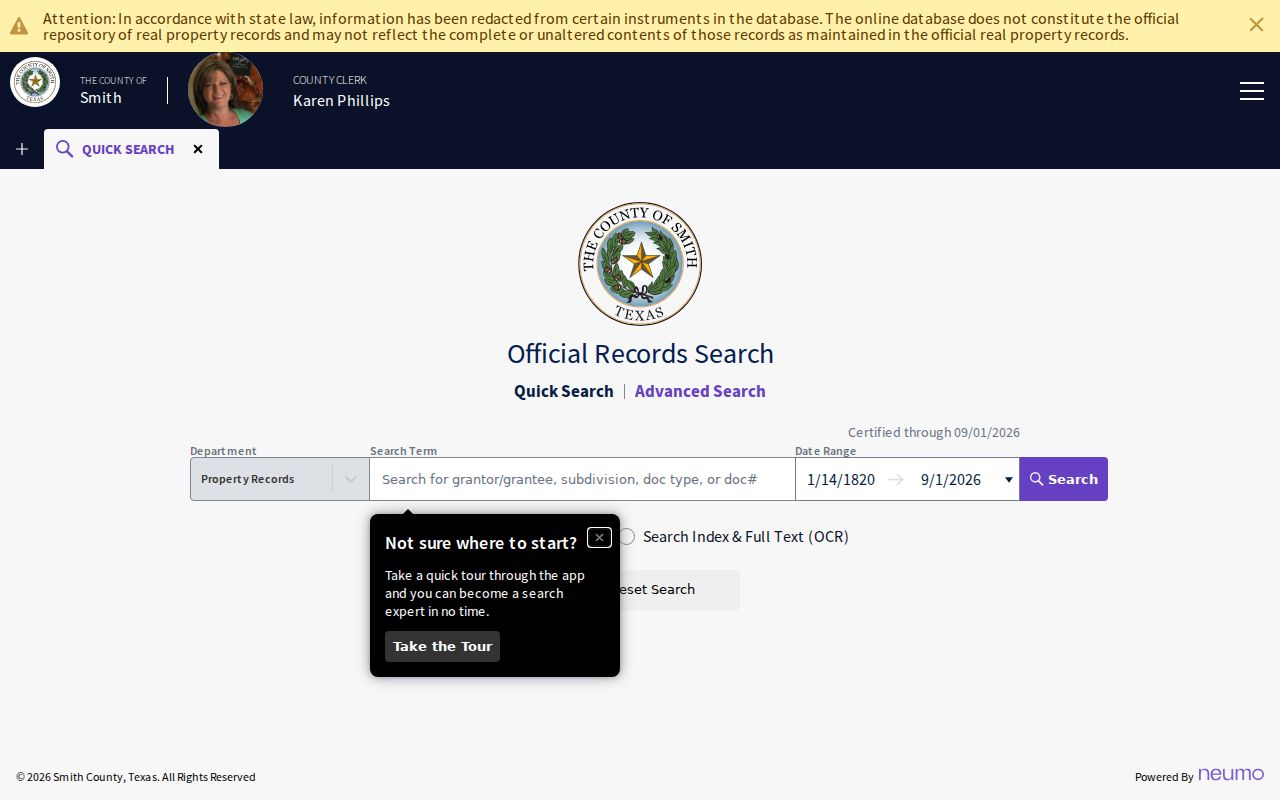
Record both search mode and date range with the result, because a phrase search and an index search can return different document trails.
Tyler Deed Chain Search Methods
A chain of title follows the transfer history of the same parcel. Begin with the current owner shown on the appraisal record, find the deed bringing that owner in, and use the seller's name to locate the earlier acquisition. A legal description often survives where a street address does not. If a name changes to an estate, trust, or business entity, inspect the instrument and continue from the party and description it identifies rather than assuming the individual trail ended.
- Copy the SCAD account, situs address, owner name, and exact subdivision, lot, block, or other legal description.
- Search the current owner's name and recorded-date range in the Official Public Records index for the purchase instrument.
- Open the available record details and note the grantor, grantee, recording date, document number or book and page, and legal description.
- Search the prior seller as a grantee in an earlier period, then compare the description before accepting it as the same parcel.
- Repeat back through matching transfers. When online results stop or the description changes, move to the Clerk or microfilm sequence instead of assigning a false cutoff year.
- Grantor / grantee
- The grantor transfers an interest in the instrument; the grantee receives it. The roles must be read within the particular document and date.
- Chain of title
- The linked series of recorded transfers for one parcel, checked by legal description and not merely by a repeated surname.
- Criss-cross directory
- A reverse address or telephone directory used to locate a listed person after the property trail establishes a time period.
- Enumeration district
- The census area's administrative subdivision, useful when a historic address is absent or its street form has changed.
Tyler Microfilm Deed Bridge
Historic deed access does not begin where the live portal ends. The Texas State Library guide documents Smith County deed records from 1846 through 1906, with indexes on reels 1863488-1863489. General index volumes A and B cover 1846-1888, while C and D cover 1888-1901, followed by detailed deed volumes through 1906. Ask the County Clerk or a microfilm librarian how the specific volume and page connect to the deed sequence.
There is a local quirk in the earliest records: Deed Volume A-1 has original and transcribed versions, and the original can contain information absent from the transcription. Index volumes also overlap. Those details make the legal description and volume citation essential when previous residents are being traced before modern address conventions.
The Texas State Library's Smith County microfilm guide lists the historical series.
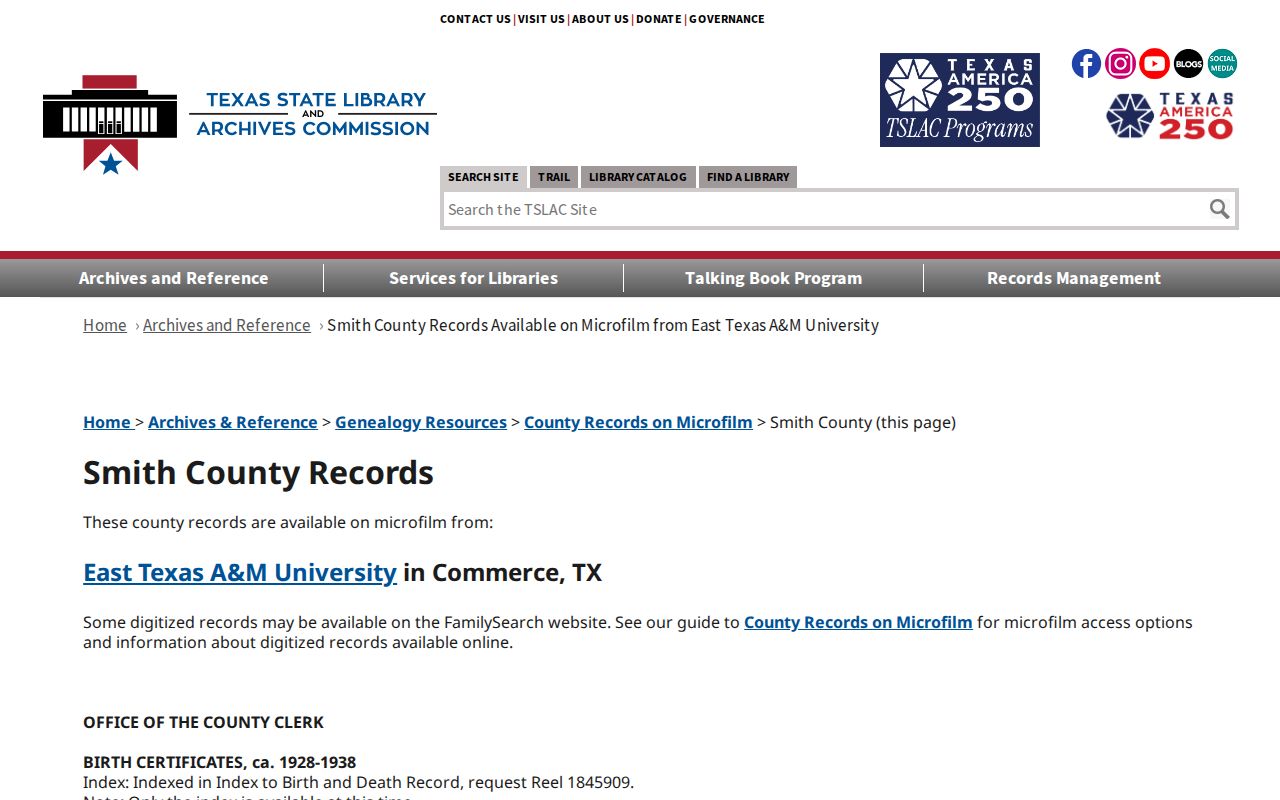
The guide supplies a documented offline route, but it does not establish that an old deed will carry a modern-looking street address.
Note: A missing online result is a portal limitation until the County Clerk or the historical volume confirms otherwise.
Tyler Previous Residents in Directories
Ownership and residence are separate questions. Once the deed chain fixes a time window, Tyler's city-directory and Kriss Kross holdings can identify a listed name at the address. The library's reverse runs cover 1958-1959, 1962-1969, 1971-1973, 1974-1988, and 1993-1994. City directories extend from 1882 to 1999 with gaps. Use the address route for an unknown name and the alphabetical route to test variants, spouses, or business clues.
Pair directory dates with the nearest public federal census. Census schedules now run through 1950 under the 72-year access rule, and 1960 will release later. The two dates can be months or years apart. A directory can carry a listed subscriber or business address; a census can describe a household at a fixed enumeration date. Neither source supplies a complete modern list.
- Set the deed transfer date beside the nearest available directory year.
- Read the address and alphabetical portions, then capture the printed street form, number, and listed name.
- Check the nearest census year and locate the relevant enumeration district when an exact historic address is unclear.
- Compare the next available directory and the next transaction for a move or handoff, without presuming a reason for a name's disappearance.
The historical volumes themselves are described in more depth on the Tyler city directory page.
Tyler Sanborn and Permit Dates
Sanborn maps date the building context, not the people. The UNT Portal to Texas History makes a Tyler 1885 Sanborn map available, and the Library of Congress guide explains that map records can be searched by city, edition date, sheet count, place names, notes, and digital files. A sheet can show a footprint, construction material, use, street names, and sometimes numbering context. Compare editions, deeds, directories, and photographs rather than treating the map as a resident roll.
For later work, Tyler eTRAKiT offers public permit, project, property, inspection, violation, issue, map, and address functions. It can supply a build or alteration lead after an address search, but the research did not establish its exact fields or historical cutoff. A permit applicant or contractor is not automatically the person who lived at the address.
The digitized 1885 Tyler Sanborn map offers a starting image for historic urban blocks.
Use the map to test whether a building or street context existed at the time, then return to deeds and directories for names.
Tyler House Files and Address Changes
The Smith County Historical Society is especially useful for a house-history request because its vertical files include “Houses (street name),” while buildings are organized by location. It also holds maps, Sanborn material, photographs, local directories, and newspapers. The Society is appointment-only, operates Tuesday through Friday from 10 to 4, and has no public browsing, photography, or scanning. Give staff the street, approximate number, construction era, former owner names, and a question narrow enough to pull material.
Historic address continuity can be difficult. Tyler's original town site had five north-south and four east-west streets around a public square, and the city was incorporated in 1850. A circa-1850 plat plus later 1961, 1972, 1984, and 1987 maps can help bridge the old and current layouts. No official year for a citywide renumbering or renaming was located. Do not invent one when an old directory number fails to match a current situs.
Note: Ask archive staff to compare a historic street form with maps before equating it to a present-day address.
Tyler Probate and Obituary Endpoints
When a name leaves an address trail, probate and obituary sources can offer a better next question than another broad search. Smith County probate indexes are online, but images are available at the County Clerk's office Monday through Friday, 8 a.m. to 5 p.m. Probate filings may include an application, heirship determination, administrator, inventory, order, or final accounting, subject to access restrictions. A will filed only for safekeeping is not public simply because it is in custody.
The Tyler Public Library holds Obituaries of Tyler, Texas Newspapers for 1905-1915, as well as other abstracted holdings that should be confirmed with the desk. Its Courier-Times and Morning Telegraph microfilm is mostly unindexed. Search the expected event date and surrounding notices. A death notice, probate item, deed distribution, and next directory should be tested together before stating that a particular person was among a property's past residents.
Smith County has records from its 1846 organization, while the early printed directory run begins in 1882. That long gap is why microfilm deeds, maps, court material, and family sources matter for early Tyler address history.