
Tyler City Directory Holdings
Tyler's documented directory run begins with an 1882 city and complete business directory and extends through listed 1999 volumes. It is not an unbroken annual sequence. The Smith County Historical Society and Tyler Public Library divide the physical collection between archive, rare-case, and shelf access. That split matters: a missing year on one shelf is not proof that no volume exists elsewhere, while a listed year still needs checking for the part of the volume that answers the question.
| Collection | Years | Where Held | Access |
|---|---|---|---|
| Tyler printed directories | 1882-1999, with listed gaps | Smith County Historical Society; Tyler Public Library | Appointment or physical volume; Society copies at $1 per page |
| Kriss Kross directories | 1958-1959, 1962-1969, 1971-1973, 1974-1988, 1993-1994 | Tyler Public Library; Society has various years | Address and telephone route to a listed name |
| Telephone books | 1920s and 1927; 1953-1959; 1960-current listed runs | Tyler Public Library | Physical holdings with published gaps and duplicate notations |
| Newspapers and obituaries | Local runs vary by title | Library and Historical Society | Microfilm, bound papers, abstracts, and staff assistance |
Begin with the year closest to the known event, then look one volume before and after. A directory can be compiled before a move or census date. Its value is in the sequence, not a single isolated entry.
Tyler Directory Years and Publishers
The collection preserves several different publishing eras. C. M. Gardner and L. M. Green issued the 1882 volume. The later local record includes Mims and Small, Southern Directory Company, Courier-Times Publishing Co., Worley, Pruden, and Polk. The 1904 Southern Directory Company volume offered private-citizen and business entries alongside a street and householder guide. In 1918, Pruden added taxpayers on ten rural mail routes with assessed property valuation, an unusual bridge between town directories and rural property history.
Polk volumes changed shape over time. The 1923-1925 editions included alphabetical private-citizen and business entries, street and householder material, and classified guides. Later editions used color-coded parts: 1993-1997 volumes identify yellow classified pages, white alphabetical pages, blue street-address pages, and numerical telephone pages. The 1998-1999 editions add a telephone key, green street guide, and pink demographic summary. Match the question to the appropriate part before treating the book as a simple name index.
The Historical Society's city-directory holdings provide the clearest local year-and-publisher list.
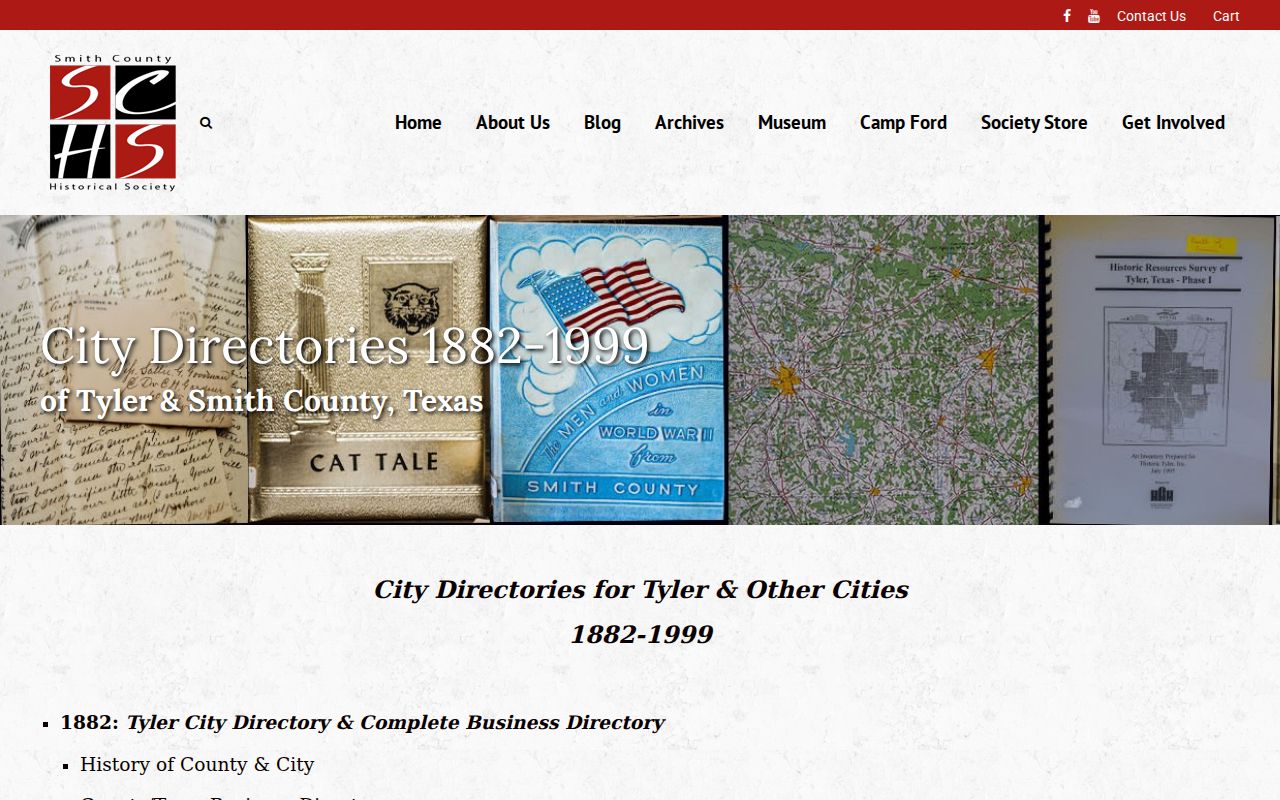
Use the holdings page to plan an appointment or copy request, then confirm the needed year and section with archive staff.
Note: The 1887 listing explicitly describes an alphabetical list limited to white inhabitants, so it cannot stand in for Tyler's whole population.
Tyler Historical Directory Shelf
The Tyler Public Library's Local and Family History room is on the third floor at 201 S. College Avenue. Its rare-book case holds directories for 1882, 1887, 1893, 1904, 1910, 1913, 1918, 1923-1925, and 1927-1930. Shelves continue with selected later years, including 1932-1940, 1942, 1947, 1950, 1952, 1954, 1956, 1958, 1960-1963, 1965-1969, 1971-1989, and 1991-1995. The library also has two microfilm machines, genealogy computers, and a book scanner.
Appointments are offered Monday and Wednesday from 10 a.m. to noon and 2 to 4 p.m., with one-hour slots and more time by arrangement. Call ahead with the surname variants, approximate year, street, and record type. Staff can help identify a directory volume, newspaper reel, map, or yearbook without guessing which collection is most likely to hold the answer.
The Tyler Public Library Local and Family History room explains its appointment-based research access.
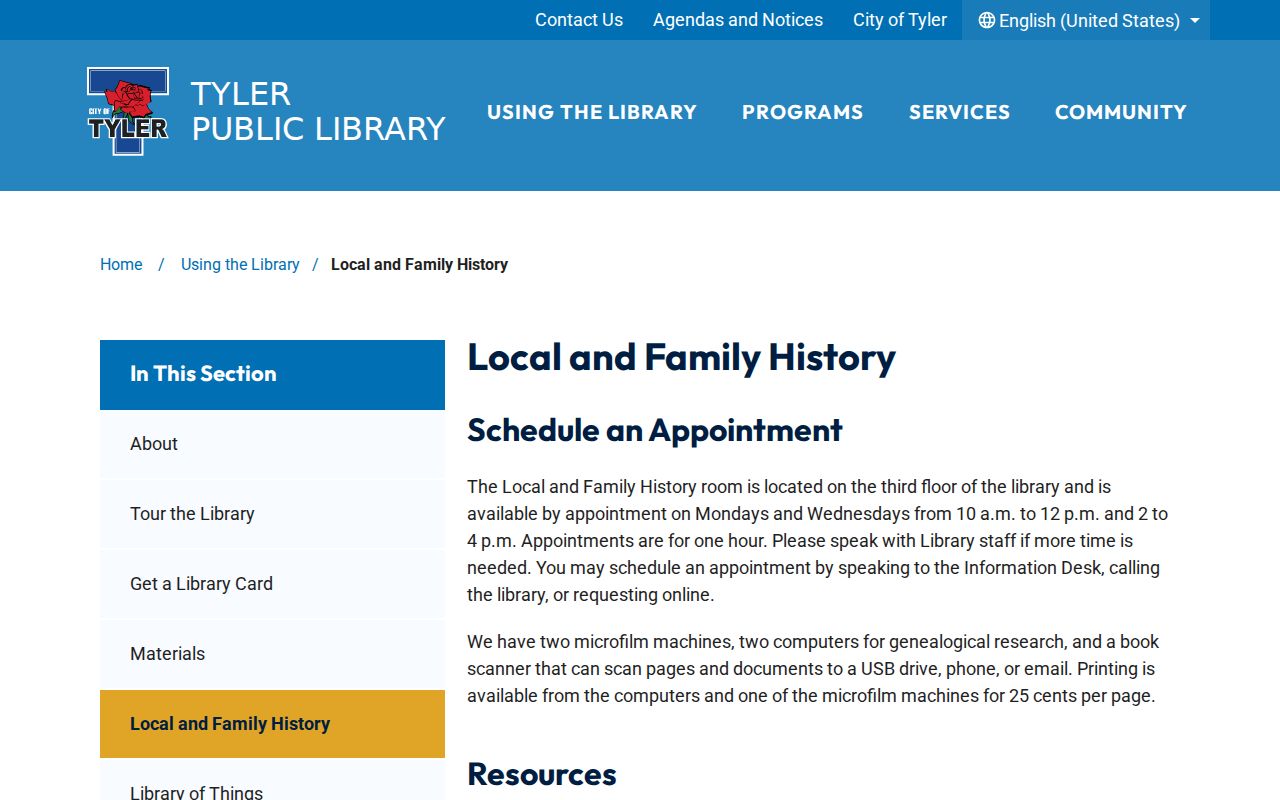
The library's room is the practical self-service stop for comparing volumes, microfilm, and companion reference works in one visit.
Tyler Directory Entry Fields
An entry must be read as evidence from a particular publisher and year. The local collection description identifies the fields likely to appear, but no official online sample establishes one universal Tyler abbreviation system. Capture the page, volume year, and the front-matter key when possible. A name may appear as an initial, a maiden or married surname, or a compound surname. Search the exact printed form as well as reasonable variants.
| Alphabetical entry | Surname, given name or initials, and sometimes a spouse reference, business affiliation, or residence. |
|---|---|
| Street guide | Street name and number with a listed occupant, business, or residence notation, depending on the volume. |
| Telephone section | A subscriber, address or business clue, and number where that portion exists. |
| Classified portion | Business name, category, address, phone, and advertising material rather than proof of a home address. |
- Criss-cross directory
- A reverse directory arranged to move from a street address or telephone number toward a listed subscriber or occupant.
- Householder guide
- The street-ordered portion that groups entries by address instead of alphabetically by surname.
- Abbreviation key
- The publisher's own front-matter explanation of marks and shortened words. Do not expand a mark from memory when the volume can settle it.
A single directory entry is a lead, not a complete identity finding. Compare dates, addresses, and related records before connecting two same-name entries.
Tyler Kriss Kross Address Layer
When the address is known but the surname is not, the Kriss Kross run is the local reverse-directory backbone. Tyler Public Library lists A.K. Wagner & Co. editions for 1958-1959, Wagner & Cole for 1962-1969, Coles for 1971-1973, then runs for 1974-1988 and 1993-1994. These books index by telephone number and street address. They can reveal a listed subscriber or occupant for a particular time period, but not every person present at that address.
Write down the street spelling and number as printed. Then check the matching alphabetical section and the earlier and later available volume. The reverse sequence is especially useful when a directory name is uncertain, but it remains affected by unlisted phones, publication timing, and the choices each publisher made about inclusion.
For a full current address-keyed record chain, use the Tyler streets directory after the historical volume has supplied a time-specific lead.
Note: A reverse-directory entry identifies a listed connection for that volume's date, not everyone associated with the address.
Tyler Newspapers Beside Historic Volumes
Directory entries become much stronger when paired with a local notice. The library holds incomplete early Tyler newspapers from 1859-1935, Tyler Courier-Times microfilm from March 1905 through October 1995, and Tyler Morning Telegraph microfilm for September 1973 and January 1981 through December 2018. Most of those reels are not indexed. Read around an expected date for obituary, wedding, social, legal, or business notices rather than relying on an empty index search.
The Historical Society adds bound Courier Times issues from 1913-1984, the Cotton Belt News index, local magazines, photographs, and school yearbooks from various years between 1909 and 2005. These materials can confirm a connection to a school, organization, street, or family event without turning a short directory entry into a claim about a modern address.
The Smith County Historical Society archives describe the wider local collection.
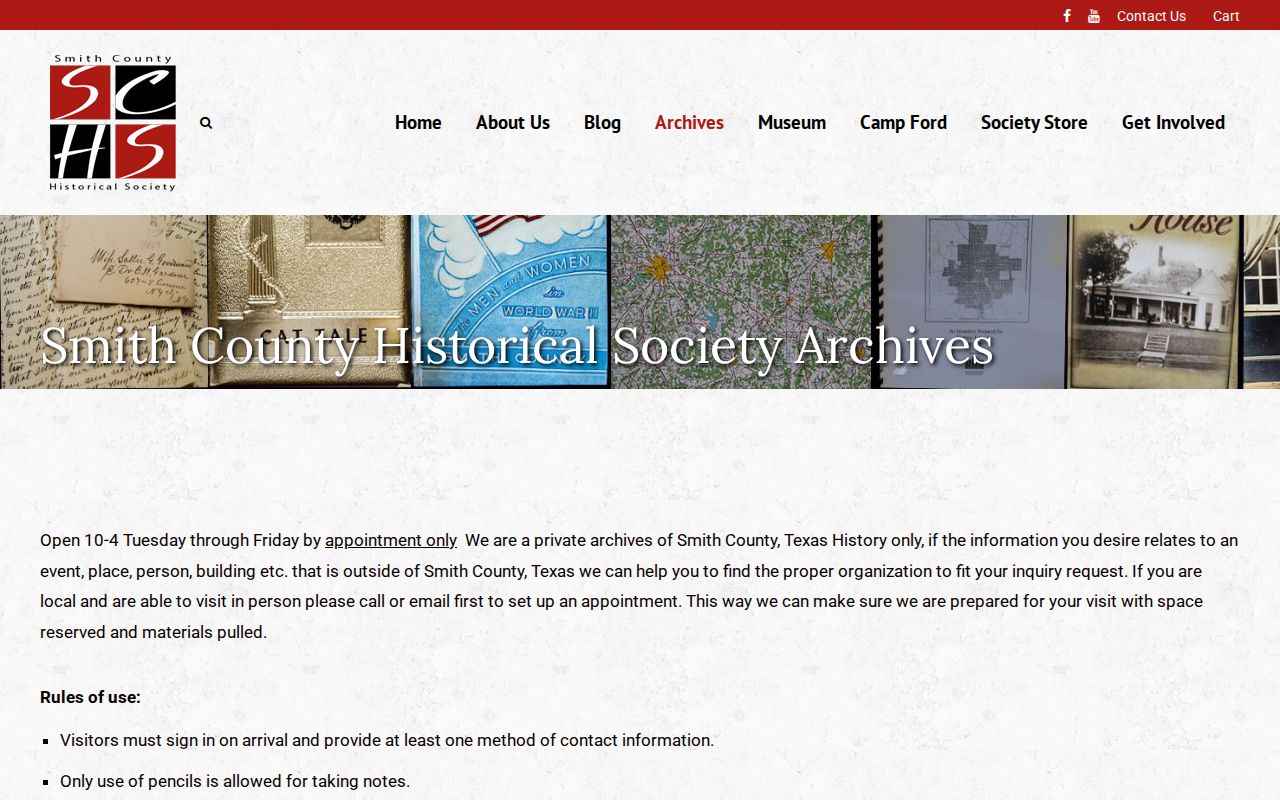
Archive requests work best when they give staff a surname, a street, a date range, and the kind of material sought.
Tracing Tyler Directory Households
Follow one household through adjacent directory years rather than jumping from decade to decade. The first appearance can establish a printed name and address. Later volumes may show a move, a new telephone, a changed business affiliation, or a widow notation. None of those changes proves why it happened. Use the sequence to choose the next record, not to fill a gap with an assumption.
- Start with the closest available alphabetical or street-guide entry and record the volume year, spelling, address, and every printed field.
- Check the preceding and following directory, including the Kriss Kross portion when that period has one.
- Pair the nearest directory with the public federal census schedule for 1900, 1910, 1920, 1930, 1940, or 1950, while keeping their different compilation dates clear.
- Use a newspaper, obituary abstract, deed, probate index, or marriage record to test a move, death, or family connection.
- Keep the source page and date with every conclusion, and leave a same-name match unresolved when the dates or addresses conflict.
Federal census schedules are public after 72 years. For Tyler, the usable public schedules currently run through 1950, while 1960 is due for later release. A directory may name a boarder or a business address that the census does not, so the two sources complement each other rather than duplicate each other.
Tyler Directory Gaps and Exclusions
A directory is not a resident census. Some people were omitted because they had no listed phone, were recorded under another name, lived outside the publisher's coverage, or were excluded by the publication's practices. The 1887 Mims and Small directory is especially clear about its racial limitation. Later sources such as African American community materials, church and school history, newspapers, maps, and family papers can be necessary to avoid repeating an old directory's omissions.
Tyler's records also contain initials, English and Spanish names, compound surnames, maiden and married names, and shortened street forms. Search a spouse, a business name, an abbreviated street, and neighboring years. A person who vanishes from a volume may have moved, died, changed a listing, or simply been left out. Treat absence as a question to investigate.
Note: The directory's inclusion choices and a missing year are limits on the source, not evidence that a person was absent from Tyler.
Tyler Maps for Directory Addresses
Maps help translate a printed street entry into a physical place. The original Tyler town site used five north-south and four east-west streets around a public square, and a circa-1850 plat is among the state archive map records. The 1882 directory and an early plat are therefore useful anchors when an old address needs context. City planning maps also preserve addition names such as Charnwood, College View, Moore Heights, Pinkerton Heights, and Willow Run, which can bridge a deed description to a later street address.
The digitized Library of Congress Sanborn research guide explains how to search map records by place, edition, and sheet.
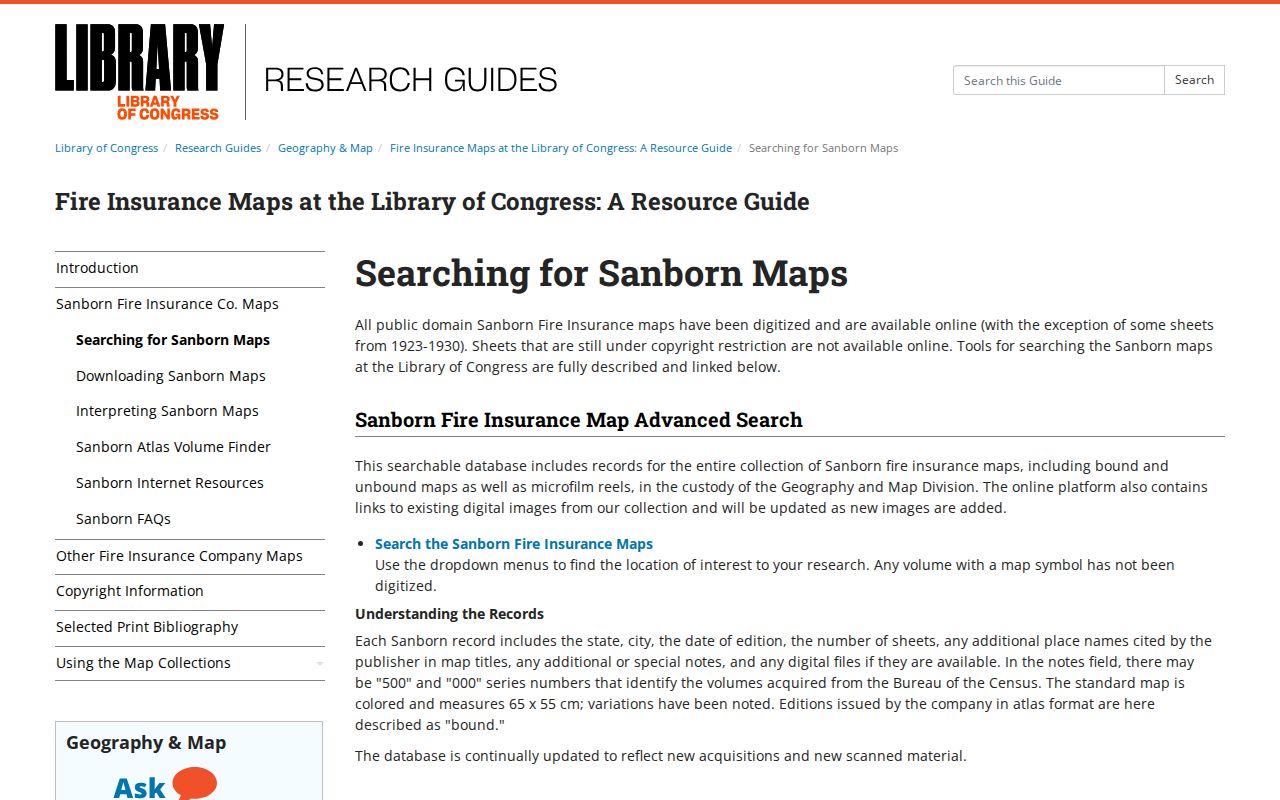
Sanborn maps can show building footprints, materials, use, and street context, but they do not identify every person who lived on a block. Compare an 1885 Tyler sheet with directory and deed dates before applying a modern number to a historic record. No official citywide renumbering or renaming year was located.